
Choosing the wrong pipe coupling can lead to disastrous leaks and costly downtime. Our guide simplifies the selection process, ensuring you get the perfect fit for a secure, long-lasting connection.
The best way to choose a pipe coupling is to systematically evaluate your specific needs. This involves understanding your pipe material and diameter, determining the pressure requirements, deciding if you need axial restraint, and considering the installation environment. Following these steps ensures a reliable, leak-free connection.
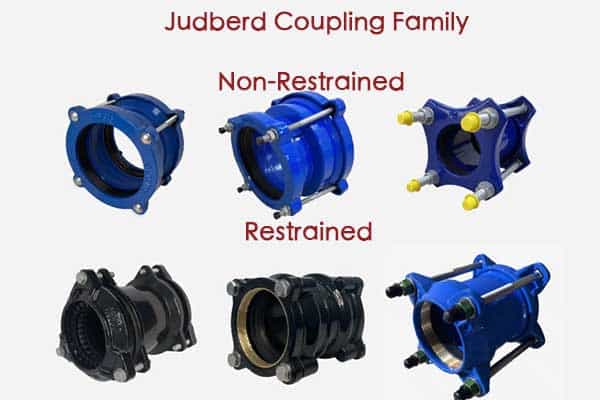
Choosing the right components for a pipeline can feel overwhelming. With so many variables, it's easy to make a mistake that could compromise the entire system. But it doesn't have to be this complicated. As a manufacturer with over 30 years of experience, we've seen it all, and we've designed this guide to walk you through the entire process, step by step. We'll break down each consideration, giving you the confidence to select the perfect coupling for any application. Let's ensure your next project is a success from the ground up.
What Is a Pipe Coupling and How Does It Work?
You know a leaky pipe is a nightmare, but you're not exactly sure how a coupling prevents it. Let us demystify this essential component for you.
A pipe coupling is a mechanical fitting used to join two pipes together. It works by using bolts to compress a gasket, which then deforms to create a durable, leak-proof seal around the outer surface of the pipes.
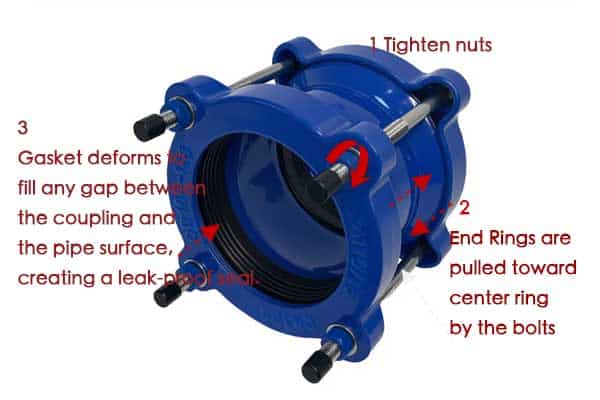
At its core, a pipe coupling is a simple yet brilliant piece of engineering. When you're installing one, you are performing a few key actions that work together to create a powerful seal. Here is the process broken down:
- Positioning: The coupling, consisting of a center sleeve, two end rings, two gaskets, and a set of bolts, is slid over the ends of the two pipes you want to join.
- Tightening: You then tighten the bolts, usually in a star or crisscross pattern to ensure even pressure.
- Compression: As the bolts tighten, they pull the end rings towards the center sleeve. This action squeezes the rubber gaskets located between the end rings and the sleeve.
- Sealing: The compressed gaskets have nowhere to go but inwards, forcing them to press tightly against the outer surface of the pipes. This deformation fills any minor imperfections on the pipe surface and creates a secure, watertight, and airtight seal.
This simple mechanism is what makes couplings so versatile and reliable for joining pipes without the need for welding or flanges.
Step 1: Understand Your Pipe Conditions (MOST IMPORTANT)?
A coupling that doesn't fit is just a piece of metal. Mismatched parts cause major installation headaches and guarantee leaks. Understanding your pipe's specifics is the first and most critical step.
The most crucial step is to identify your pipe material (e.g., ductile iron, steel, PVC), its exact Outer Diameter (OD), and any potential misalignment. This data is essential for selecting a coupling that will fit correctly and seal effectively.
Before you even think about pressure or environment, you must know your pipe inside and out. This is the foundation of a successful connection, and getting it wrong leads to project delays and failures. As a manufacturer, this is the first set of questions we ask any customer.
✔ Pipe Material
The material of your pipe—be it Ductile Iron (DI), Steel, PVC, HDPE, or Asbestos Cement (AC)—affects everything. It influences the pipe's outer diameter, surface texture, and strength, all of which are critical factors in choosing the right coupling and gripping system.
✔ Pipe Outer Diameter (OD) & Tolerance
This is non-negotiable. You must know the exact OD of your pipes. Don't rely on the nominal pipe size (DN), as the actual OD can vary between materials and manufacturing standards. Measure it. A coupling is designed to work within a specific tolerance range, and your pipe's OD must fall within that range for the gasket to seal properly.
✔ One coupling fits multiple pipe sizes
For smaller diameters (typically DN1000 and below), we often design "wide range" couplings . This means a single coupling model can connect pipes with different ODs within its stated range. For example, one coupling might fit DI, steel, and PVC pipes of the same nominal size. This is a huge advantage for wholesalers and contractors as it dramatically reduces the amount of inventory you need to carry.
✔ Alignment Condition
Are the two pipes perfectly aligned, or is there a slight angle or gap between them? Standard couplings require good alignment, while flexible couplings are designed to accommodate a few degrees of angular deflection. Being honest about the site conditions will help you choose a coupling that won't be stressed from day one.
Step 2: Determine Pressure Requirements (PN / PSI)?
A coupling failure under pressure is catastrophic. Guessing the pressure rating is a dangerous game. We'll show you how to match the coupling to your system's pressure safely.
You must select a coupling with a pressure rating (PN or PSI) equal to or greater than your pipeline's maximum operating pressure. This ensures the coupling can safely withstand internal forces without leaking or failing.
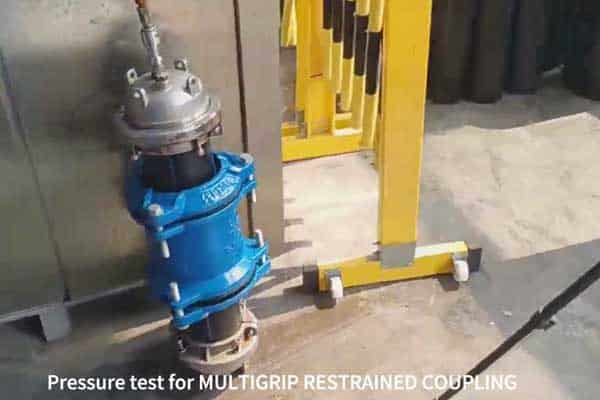
The pressure rating, often expressed in PN (a European standard roughly equivalent to bars) or PSI (pounds per square inch), is a measure of the coupling's strength. Choosing an underrated coupling is a major safety risk. The materials used in the coupling are directly related to its pressure-handling capability.
Based on our 30 years of manufacturing experience, we have clear recommendations:
- For pressures up to PN25 (approximately 365 PSI): We recommend using couplings made from ductile iron. Ductile iron offers an excellent combination of high strength, stability, and competitive cost, making it the ideal choice for the vast majority of water and wastewater applications.
- For pressures higher than PN25: We strongly suggest using couplings made from fabricated carbon steel. Ductile iron is generally not suitable for these very high-pressure scenarios.
- For very large diameters (DN ≥ 2000): Carbon steel is also the preferred material. The market demand for such large sizes is limited, making the cost of creating ductile iron casting molds prohibitively expensive. Fabricated steel provides a more economical and equally robust solution.
Always check the manufacturer's specifications and ensure the coupling's pressure rating meets or exceeds your pipeline's design pressure.
Step 3: Do You Need a Restrained Coupling?
A pipe pulling apart is a disaster. But are expensive restrained couplings always necessary? Knowing when to use them saves money and prevents catastrophic failure.
Use a restrained coupling when the pipeline lacks external anchoring to counteract thrust forces from pressure, especially at bends or dead ends. They are also mandatory for joining slippery materials like HDPE pipe.
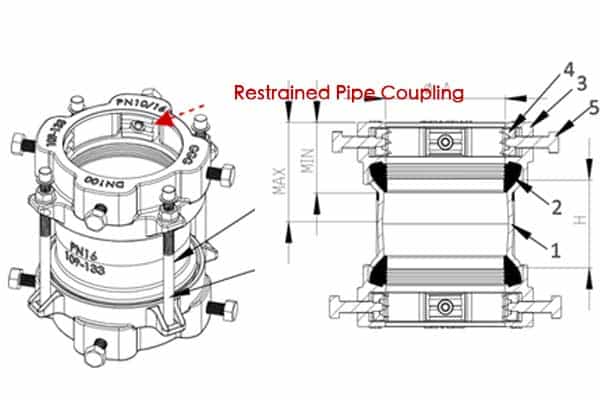
When water flows through a pipe, it creates powerful forces, known as axial thrust . These forces try to push the pipes apart, especially at points where the flow changes direction ( bends, tees ) or stops (end caps). A standard, non-restrained coupling only seals the pipe; it does not prevent it from pulling out. A restrained coupling does both: it seals the joint and mechanically grips the pipes to stop them from separating.
When you MUST use restrained coupling:
- No Anchoring: If the pipeline is not secured by concrete thrust blocks or proper soil backfill. In above-ground pipelines, restraint is almost always required.
- Changes in Direction: At all bends, tees, and reducers where thrust forces are highest.
- HDPE Pipes: HDPE is a smooth, flexible material prone to "creep " under pressure. A standard coupling cannot get a good grip. Restrained couplings with specialized 360° gripping systems are mandatory for HDPE to prevent pull-out.
- Steep Slopes: To prevent pipes from sliding apart due to gravity and pressure.
When non-restrained is OK:
A non-restrained coupling is perfectly acceptable and more economical when the pipeline is fully and properly anchored. This usually means it is buried and compacted with appropriate backfill, or it has concrete thrust blocks at all change-of-direction points that absorb the thrust forces. If the pressure exceeds 6 bar (approx. 90 PSI), we strongly advise considering restrained solutions if the pipeline is not properly anchored .
Step 4: Consider Installation Conditions?
Can't fit your tools in a tight spot? Working on an old, tricky pipe? The installation site itself presents unique challenges that can derail a project if not considered beforehand.
Analyze the physical space and project type. Compact couplings are best for tight quarters. For repairs and retrofits, couplings offer a quick, no-weld solution. For large-diameter pipes, plan for specialized handling.
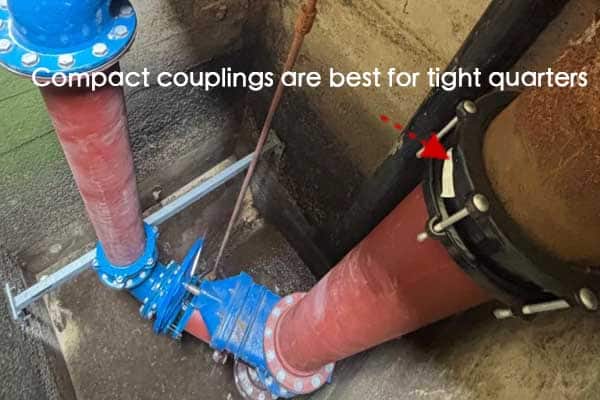
The best coupling in the world is useless if you can't install it properly. Thinking about the "where" and "how" of the installation is a crucial step that is often overlooked during the design phase.
Limited Space?
In crowded pipe galleries, deep trenches, or plant rooms, there often isn't much room to work. A bulky coupling with long bolts can be impossible to install. In these situations, look for compact-design couplings. They are engineered to have a smaller footprint and may use shorter bolts or a different tightening mechanism, making them much easier to install when space is at a premium.
Retrofit Projects?
Couplings are the hero of repair and maintenance projects. When you need to cut out a damaged section of pipe and replace it, a coupling is infinitely faster and safer than welding or installing new flanges. There's no hot work permit required, less need for perfect alignment, and the installation is measured in minutes, not hours. This drastically reduces system downtime.
Large Diameter Pipelines?
Installing couplings on large pipes (e.g., DN1500 and above) is a different ball game. The components are heavy and require lifting equipment. For these critical main transmission lines, stability is paramount. We often recommend a special harness-type welded structure. This involves welding harness to the pipe, which are then connected by long bolts to the coupling structure. While more complex to install, this design provides the ultimate security against pipe pull-out and is the optimal solution for ensuring the long-term stability of major pipelines.
Step 5: Choose the Right Gasket Material?
The gasket seems like a small part, but it's the heart of the seal. The wrong material can degrade quickly from the fluid inside or the environment outside, causing leaks.
The gasket material must be compatible with the fluid inside the pipe. EPDM is the standard for drinking water and wastewater, while NBR is used for oils, fuels, and greasy water.
The gasket is the only part of the coupling that directly touches both the pipe and the fluid it carries. Its chemical compatibility is therefore essential for a long-lasting seal. Choosing the wrong material can lead to the gasket swelling, cracking, or breaking down, which will inevitably result in a leak. As your manufacturing partner, we can provide gaskets for any application, but the most common choices are clear.
| Gasket Material | Common Use | Temperature Range | Key Characteristics |
|---|---|---|---|
| EPDM | Drinking Water, Wastewater | -30°C to 120°C | Excellent resistance to weather, ozone, and water. |
| NBR (Nitrile) | Oils, Fuels, Hydrocarbons | -20°C to 100°C | Excellent resistance to oil and grease. |
| FKM (Viton) | Aggressive Chemicals, High Temps | -20°C to 200°C | Superior chemical and heat resistance, higher cost. |
For our typical customers in the waterworks industry, EPDM is the universal standard. We ensure that our EPDM gaskets meet stringent international hygiene standards for drinking water applications, such as WRAS or NSF/ANSI 61. This guarantees that the material is safe and will not contaminate the water supply.
Step 6: Consider Environment (Corrosion & Movement)?
Your pipe connection is constantly under attack from the outside world. Corrosive soil, ground shifts, and temperature changes can all degrade and destroy a coupling if it's not prepared for them.
For corrosive environments, choose couplings with superior corrosion protection like Nylon 11 coating. For pipelines subject to ground settlement, vibration, or thermal expansion, flexible couplings are essential to absorb movement.
A pipeline's service life depends not only on its ability to handle internal pressure but also on its resilience to external threats. The coupling, as a key component, must be specified with these threats in mind.
Corrosive environment?
If your pipeline is buried in aggressive soil, located in a coastal area with salt spray, or in an industrial setting with chemical exposure, corrosion is your number one enemy. The standard paint on a coupling won't last long. In these cases, you must specify a higher level of corrosion protection.
- Nylon 11 coating: This is the industry standard for serious protection. The coating is applied as a powder to a heated coupling and fuses to the surface, creating a thick, durable, and continuous barrier against moisture and chemicals.
- Stainless Steel Components: For the ultimate protection, especially on bolts and nuts which are often the first points of failure, specify stainless steel (Grade 304 or 316). This significantly increases the cost but may be necessary in the most aggressive environments.
Thermal expansion / vibration?
Pipelines are not static. They expand and contract with temperature changes, and they can be subject to vibrations from nearby machinery or traffic. A rigid connection like a weld or flange can be stressed by this movement, leading to fatigue failure. A flexible pipe coupling, however, is designed to allow for a certain amount of expansion , contraction , and angular deflection . This flexibility absorbs the stresses, protecting the pipe and the joint, and ensuring a much longer service life for the entire system.
Step 7: Choose Between Standard vs Wide Range Coupling?
Stocking dozens of specific coupling sizes is a logistical nightmare. But will a "one-size-fits-most" coupling really provide a reliable seal? Understanding the difference is key to efficiency and reliability.
Wide range couplings cover multiple pipe ODs, reducing inventory, and are great for smaller diameters (DN ≤ 1000). For larger pipes, standard (dedicated) couplings are safer to prevent deformation and ensure a perfect seal.
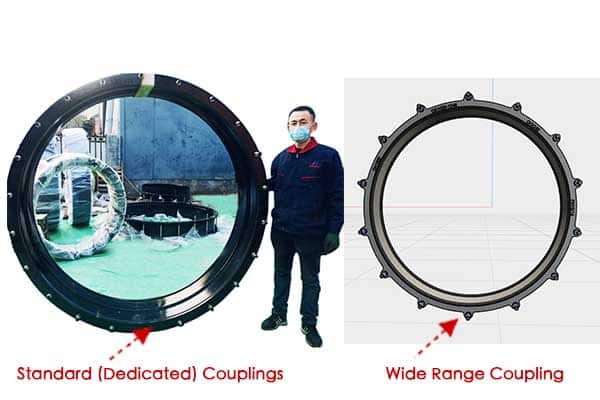
When you look at a supplier's catalog, you'll see couplings listed with a "nominal range." This tells you the minimum and maximum pipe OD that the coupling can accommodate. This leads to a choice between two main types.
Standard Coupling
A standard or "dedicated" coupling has a very small tolerance range, often just a few millimeters. It is designed to fit one specific pipe type and size perfectly. This provides the most robust and reliable connection, but it requires you to know your pipe OD exactly and to stock a different coupling for every pipe variation.
Extended Range Coupling (HIGHLY RECOMMENDED)
An extended range or "wide range" coupling has a much larger tolerance, often 20-30mm. This is the type we highly recommend for most applications up to DN900.
- Benefit: The primary benefit is inventory reduction. One coupling can connect ductile iron pipe, steel pipe, and PVC pipe of the same nominal size, even though their actual ODs differ. For a distributor or large contractor, this means less money tied up in stock and always having a fitting that can solve a problem on site.
- Caveat: There's a limit. If the range is too wide, the gasket may not compress enough to seal a pipe on the smaller end of the range. That's why we engineer our couplings with a carefully calculated range—typically 20-30mm—that provides maximum flexibility without compromising sealing performance. For very large diameters (above DN1000), the risk of the center sleeve deforming becomes too high, so we recommend switching back to standard, dedicated-size couplings for guaranteed reliability.
Common Real-World Scenarios (And Solutions)?
Theory is one thing, but the real world is messy. You face mismatched pipes, misaligned lines, and difficult materials. What's the practical solution for these common problems?
Use wide-range couplings to connect different materials (e.g., steel to PVC). Flexible couplings handle misalignment. Reducer couplings join different diameters. Use restrained couplings with special grips for HDPE pipe.
As a manufacturer that provides OEM/ODM services, we help engineers and project managers solve these exact problems every day. Here are some of the most common challenges and the simple coupling-based solutions.
✔ Connecting Different Materials (Steel to PVC / HDPE)
This is a classic problem in repair or expansion projects where you're connecting a new pipe to an old one. A wide-range coupling is the perfect solution. As long as the ODs of both the steel pipe and the PVC pipe fall within the coupling's range, it will bridge the connection seamlessly, creating a tight seal on both.
✔ Pipes Not Aligned
It's rare for two pipes in a trench to be perfectly aligned. Ground settlement, installation errors, or intentional long-radius curves mean you'll often have some angular deflection. A flexible pipe coupling is designed for this. It can accommodate several degrees of misalignment while maintaining a perfect seal, preventing stress on the pipe.
✔ Different Pipe Diameters
What if you need to connect a DN150 pipe to a DN100 pipe? You need a reducer. While you can use a combination of flanges and a flanged reducer, a much simpler solution is a reducing coupling . This is a single fitting designed with a different diameter at each end, allowing you to step down the pipe size in one easy-to-install component.
✔ HDPE Pipe Systems
We've mentioned it before, but it bears repeating because it's so important. HDPE pipe is slippery and prone to changing shape under pressure (creep). You must use a restrained coupling. Our design for HDPE features a 360° gripping system that clamps down uniformly around the pipe, providing maximum hold without creating a single point of stress that could damage the pipe wall.
Why Pipe Connections Fail (And How to Avoid It)?
A connection failure means emergency calls, costly shutdowns, and potential environmental damage. Understanding why they fail is the first step to making sure it never happens to you.
Connections typically fail due to incorrect coupling selection or improper installation, especially uneven bolt tightening. Avoid this by using our selection guide and ensuring installers use a torque wrench and a star-tightening pattern.
In our experience, a coupling that meets its design specifications rarely fails on its own. The failure is almost always linked to a human error during the selection or installation phase.
1. Incorrect Selection
This is the root of many problems. Using a non-restrained coupling in an unrestrained application, using a PN10 coupling in a PN16 system, or using a coupling where the pipe OD is at the very edge of its tolerance range are all recipes for failure. Following the steps in this guide prevents these errors.
2. Improper Installation
This is the most common cause of leaks. The bolts on a coupling must be tightened evenly to ensure the gasket compresses uniformly. If an installer tightens one bolt all the way before moving to the next, the end ring will tilt, pinching the gasket on one side and leaving it loose on the other. This creates a clear leak path.
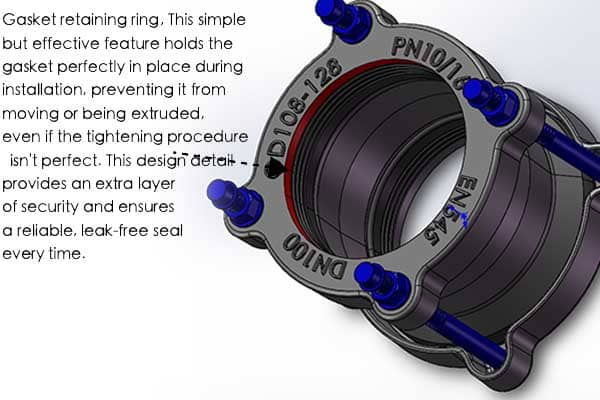
To prevent this, we have engineered a solution. Many of our Judberd couplings feature a built-in gasket retaining ring. This simple innovation holds the gasket securely in place within the end ring, preventing it from shifting or extruding even during uneven tightening. It's a small detail that provides a massive improvement in installation reliability and leak prevention.
When Should You Use a Pipe Coupling Instead of Welding?
Welding seems like the strongest option, but it's slow, requires a certified welder, and involves dangerous hot work. Is there a faster, safer, and equally reliable alternative?
Use couplings for repairs, retrofits, in tight spaces, or anytime hot work is not desirable. Couplings are faster to install, require only basic tools, and can accommodate misalignment, unlike rigid welding.
Welding and couplings are both excellent methods for joining pipes, but they are suited for different situations. Choosing the right one can save you significant time and money. Here is a direct comparison:
| Feature | Pipe Coupling | Welding |
|---|---|---|
| Speed | Very Fast (minutes per joint) | Slow (hours per joint) |
| Skills Required | Basic mechanical skills | Certified welder required |
| Hot Work Permit | No | Yes (fire risk, need for fire watch) |
| Alignment | Tolerates several degrees of misalignment | Requires near-perfect alignment |
| Dissimilar Pipes | Excellent for joining different materials | Requires special procedures, often not possible |
| Disassembly | Easy to remove for maintenance | Joint must be cut out and destroyed |
| Best For | Repairs, retrofits, field work, tight spaces | New construction, high-pressure fabrication |
For new, long-run pipeline construction in a controlled environment, welding is a great choice. But for almost every other scenario—especially repairs, maintenance, and connecting to existing infrastructure—a pipe coupling is the superior, more efficient, and safer solution.
Is a Pipe Coupling a Permanent Solution?
You need a fix that lasts. Is a pipe coupling just a temporary patch, or can you trust it for the long haul? Let's settle this common concern once and for all.
Yes, a correctly selected and installed pipe coupling is a permanent, engineered solution designed to last the lifetime of the pipeline. They are not temporary fixes and offer the same durability as the pipes they connect.
This is a misconception we often encounter. Perhaps because they are so easy to install, some people assume couplings are a temporary or "lesser" solution. This is completely false. Modern pipe couplings are highly engineered products designed for long-term performance.
Think about how they are made. At our factory, we use high-strength ductile iron, the same material used for the pipes themselves. We protect them with industrial-grade coatings like fusion-bonded epoxy, the same protection used on the pipeline. The bolts are high-tensile steel, and the gaskets are made from synthetic rubbers designed to resist degradation for decades.
A well-made coupling, designed and tested to international standards like AWWA C219 or EN 545 , is engineered to have a service life of 50 years or more. When you install one of our couplings, you can be confident that you are installing a permanent part of the pipeline infrastructure.
Final Checklist (Engineering Selection Guide)?
Feeling overwhelmed by all the details? Worried you'll forget a critical step? A simple checklist can be your best friend during the selection process, ensuring you cover all your bases.
Before ordering a coupling, run through this checklist: Pipe Material? Outer Diameter? Pressure? Restraint Needed? Fluid Type? Installation Environment? This simple check ensures you've considered every variable.
Use this as your final check before you send a purchase order. Answering these questions will give you and your supplier all the information needed to select the perfect coupling.
- [ ] 1. Pipe Material: What are the pipes made of? (e.g., Ductile Iron, Steel, PVC, HDPE)
- [ ] 2. Pipe Outer Diameter (OD): What is the exact measured OD of each pipe? (e.g., 168.3 mm)
- [ ] 3. Pressure: What is the maximum operating pressure of the system? (e.g., PN16 / 235 PSI)
- [ ] 4. Restraint: Is the pipeline anchored? Do you need a restrained coupling? (e.g., Yes, bend)
- [ ] 5. Fluid: What is flowing through the pipe? (e.g., Drinking Water, Sewage, Oil)
- [ ] 6. Gasket: Based on the fluid, what gasket is needed? (e.g., EPDM for water)
- [ ] 7. Environment: What are the external conditions? (e.g., Buried in corrosive soil)
- [ ] 8. Coating: Based on the environment, what protection is needed? (e.g., FBE coating)
- [ ] 9. Alignment: Will the pipes be perfectly aligned? (e.g., Up to 3° deflection)
- [ ] 10. Installation: Are there space constraints or other challenges? (e.g., Tight trench)
If you can answer all these questions, you are well on your way to a successful, leak-free project. If you're unsure about any of them, don't guess—contact us. We are here to help.
How much misalignment can a coupling handle?
Wondering if a coupling can handle a slight bend in your pipe run? You need to know the limits of its flexibility to avoid putting stress on the joint.
A standard flexible pipe coupling can typically accommodate 2 to 4 degrees of angular deflection. The exact amount depends on the coupling's specific design and the diameter of the pipe.
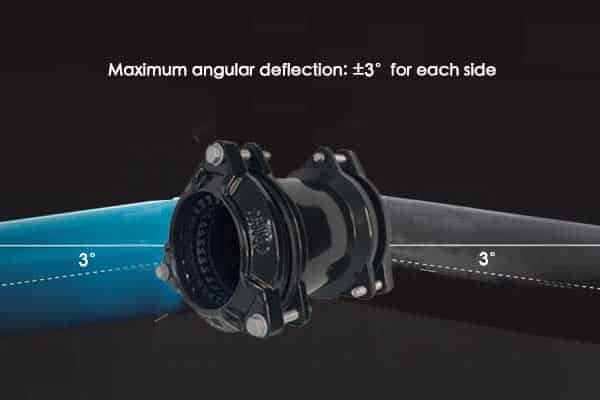
This built-in flexibility is one of the great advantages of using a coupling. It allows for minor ground settlement, gentle pipeline curves without needing special bend fittings, and absorbs vibrations. The allowable deflection is specified by standards like AWWA C219 and is a key performance indicator for any flexible coupling. It's important to note that this is designed to handle a static, installed angle. It is not intended for constant dynamic movement, for which you would need a specialized expansion joint. Always check the manufacturer's data sheet for the specific deflection rating of the coupling you are considering.
What pressure can a pipe coupling handle?
You need to be certain your chosen coupling can handle the force inside your pipeline. Mismatching pressure ratings is a critical safety issue that cannot be overlooked.
Pipe couplings are available in a wide range of pressure ratings, commonly from PN10 (150 PSI) to PN40 (600 PSI). Specialized designs can handle even higher pressures.
The pressure rating is a fundamental specification. You must always choose a coupling with a rating that is equal to or higher than the maximum operating pressure of your system, including any potential surge pressures. As a manufacturer with OEM capabilities, we can design and produce couplings for specific customer requirements. For standard applications, ductile iron couplings are typically rated for PN10 or PN16. For higher pressures up to PN25 or PN40, we use different material grades or switch to fabricated carbon steel designs to ensure absolute safety and reliability.
Can one coupling fit multiple pipe sizes?
Tired of stocking countless different sizes of fittings for every possible pipe? You're hoping there's a more efficient way to manage your inventory for repairs and new projects.
Yes, absolutely. Extended or "wide range" couplings are specifically designed to fit a range of different pipe Outer Diameters (ODs), making them extremely versatile and cost-effective.
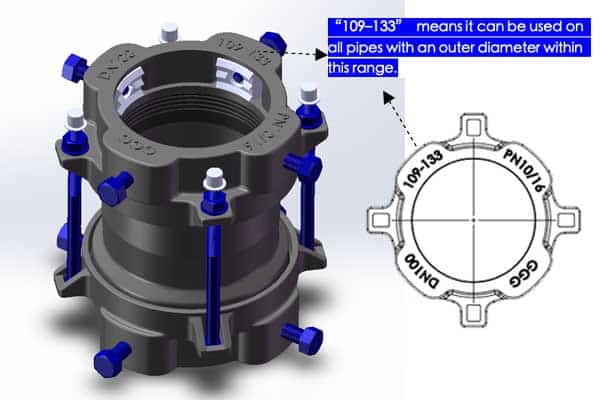
This is one of the most practical innovations in pipe joining technology. For pipe sizes up to around DN1000, using wide-range couplings is a smart strategy. A single DN150 wide-range coupling, for instance, can connect not only different types of DN150 pipe (DI, steel, PVC) but can also handle variations in manufacturing tolerances. This significantly reduces the amount of stock a contractor or distributor needs to carry, saving space and money. For the end-user, it means having a higher chance that the fitting you have on the truck will solve the problem you find in the ground.
Why is my coupling leaking?
You followed the instructions, but you see a dreaded drip. A leaking coupling is frustrating and can undermine confidence in the product. Let's look at the most likely cause.
The most common reason for a new coupling to leak is improper installation, specifically uneven bolt tightening. This causes the gasket to shift and create a gap, resulting in a leak.
When bolts are not tightened in an alternating, star-like pattern, one side of the coupling gets compressed more than the other. This tilts the end ring and pinches the gasket, preventing it from sealing uniformly around the pipe's circumference. Using a torque wrench to apply the correct force and tightening in stages is crucial.
Recognizing this common installation error, we at Judberd have designed a solution. Many of our couplings feature a gasket retaining ring within the end ring. This simple but effective feature holds the gasket perfectly in place during installation, preventing it from moving or being extruded, even if the tightening procedure isn't perfect. This design detail provides an extra layer of security and ensures a reliable, leak-free seal every time.
Conclusion
Choosing the right coupling is simple when you follow these steps. By understanding your pipe, pressure, and environment, you can confidently select a secure, permanent connection for your pipeline.
