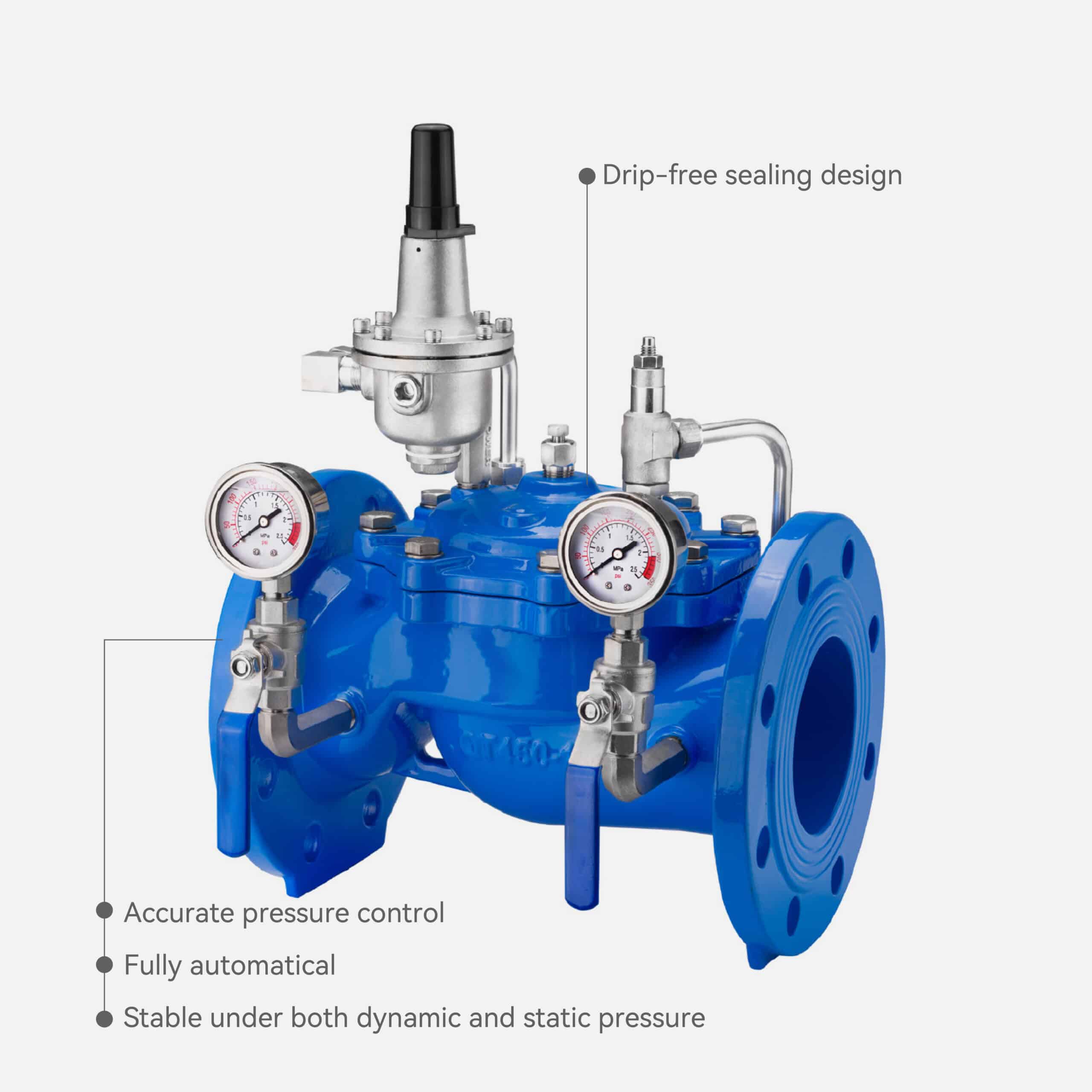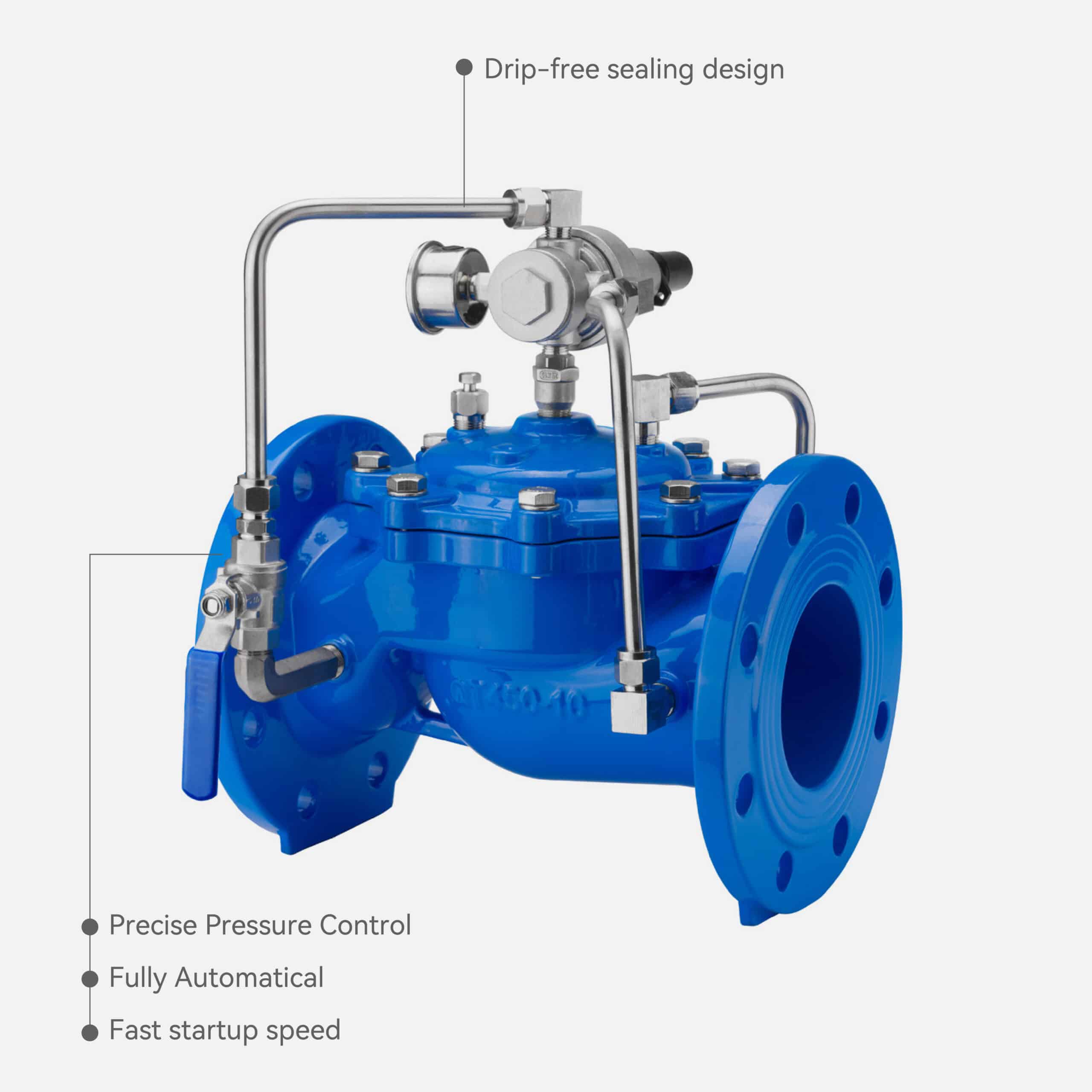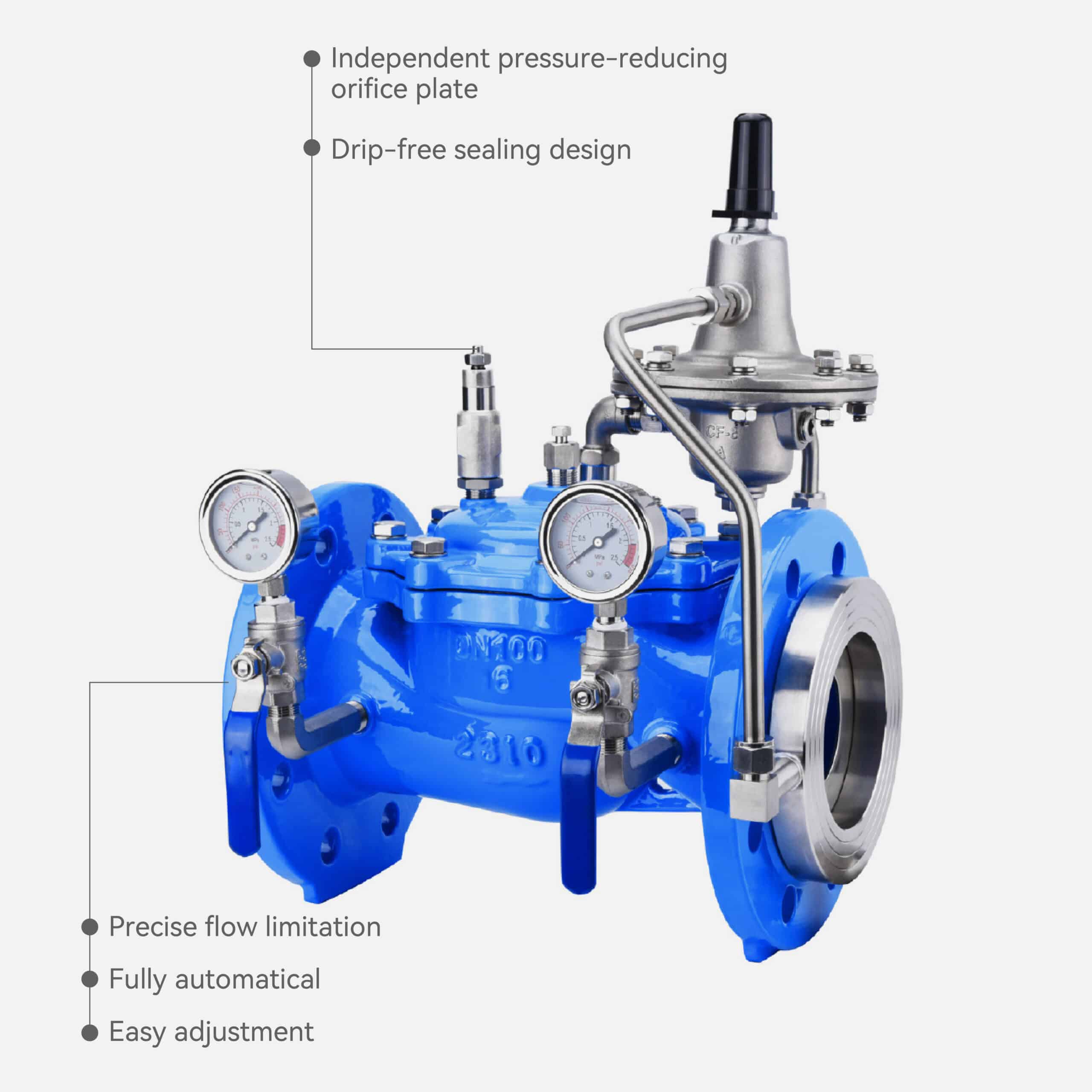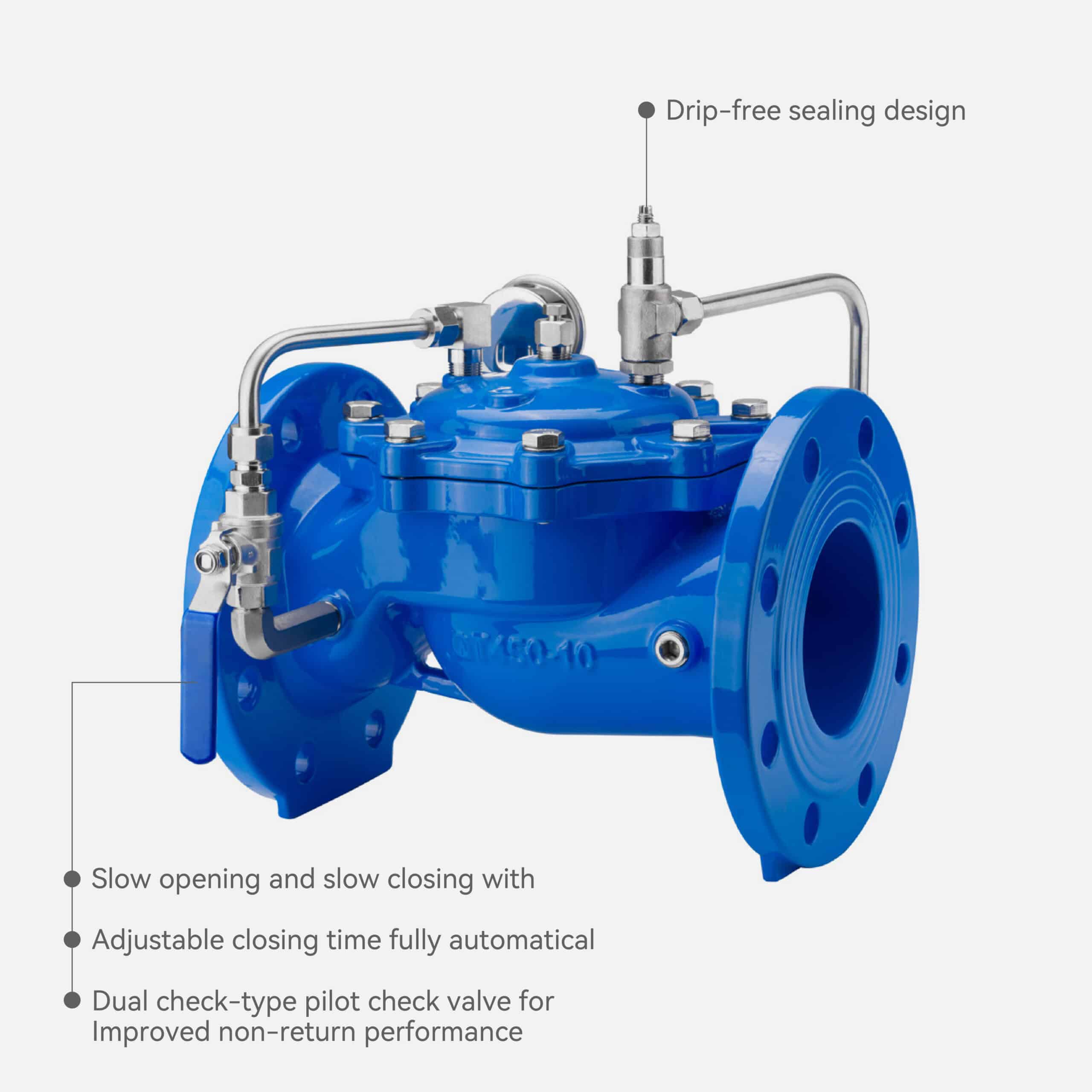
Differential Pressure Control Valve
Differential Pressure Control Valve is a hydraulic, pilot-operated diaphragm valve designed to automatically maintain a constant pressure difference between the supply and return lines of a water system.
It consists of a main control valve and a pilot differential-pressure balancing valve. The pilot senses the pressure difference and adjusts the main valve opening accordingly—no external power is required, as the valve operates purely by system pressure.A DPCV is used to stabilize the differential pressure between supply and return lines, ensure constant flow to coils and branch circuits, even when system load changes, prevent flow fluctuations, noise, and vibration caused by excessive pressure, improve system balance and reduce energy consumption in HVAC chilled-water and condenser-water systems, protect pumps, coils, and control valves by avoiding excessive differential pressure.
Differential pressure control valve keeps the system pressure difference steady, ensuring reliable, stable, and efficient operation of the HVAC water network.
Feature
● Nominal Diameter: DN40–DN800
● Sealing Material: EPDM or NBR
● Operating Temperature: ≤ 80°C
● Applicable Medium: Clean water
● Body Material: Ductile iron, brass, 304/316 stainless steel
● Adjustable Differential Pressure Range:
PN10: 0.2–0.8 MPa
PN16: 0.2–1.2 MPa
Circulation Loop Flow Control
Drip-free Sealing Design
Precise Differential Pressure Regulation
Fully Automatical
Control of the Maximum Flow Through The Pump
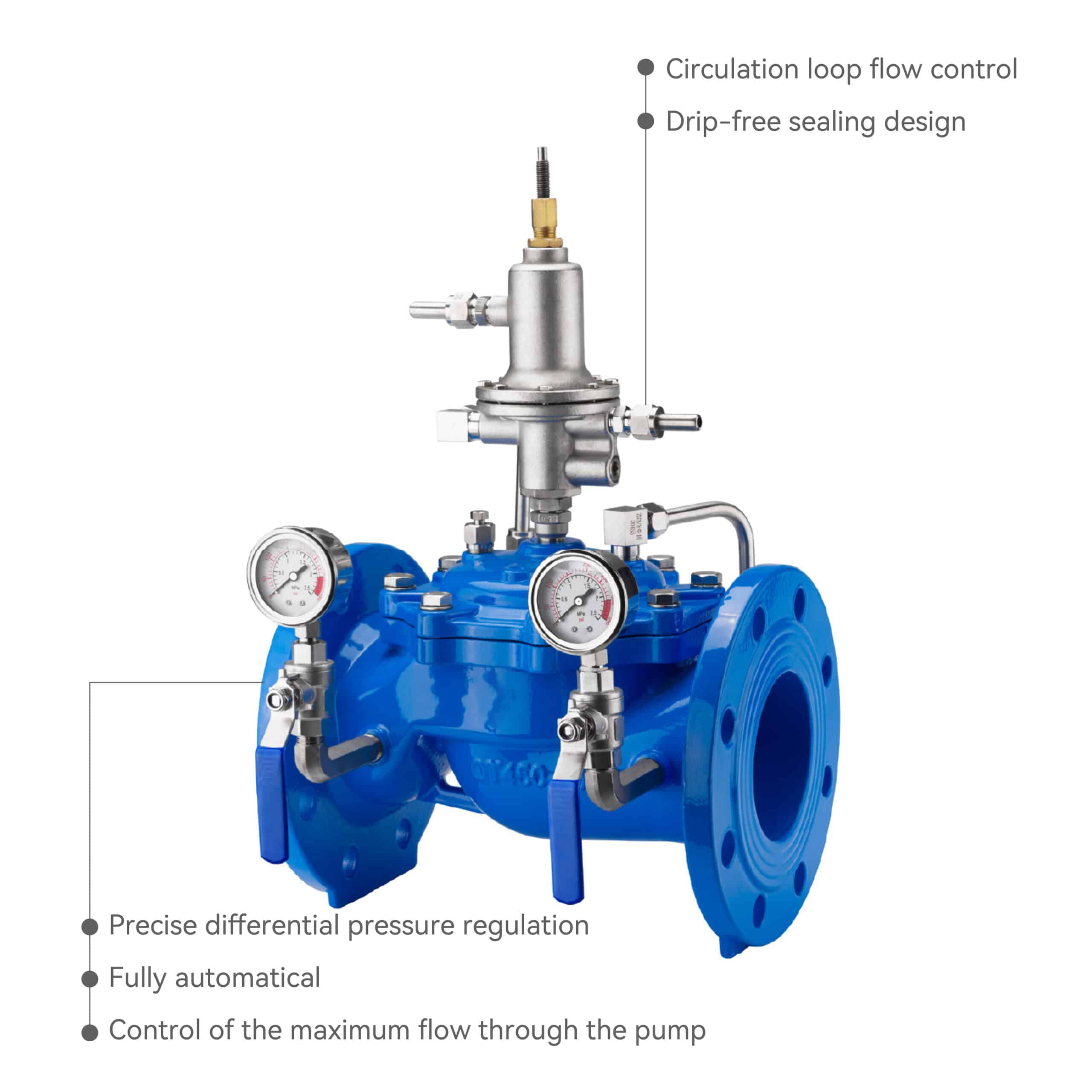
Structure of Differential Pressure Control Valve
Differential pressure control valve (DPCV) is made up of a few parts that work together to keep the pressure difference between the supply and return stable.
Here’s explanation of each part and how they work together.
1, The Big Valve That Opens and Closes (Automatic Control Valve)
_
This is the big valve that opens and closes to control the flow. It has a diaphragm inside that moves up or down. It opens and closes based on the pressure signals. It controls how much water goes through the branch.
The pilot valve tells the big valve when to open or close. The diaphragm reacts to the pilot signals and changes the opening of the valve.
2, The Little Valve That Tells the Big Valve What to Do (Pilot Valve)
_
This is the little control valve that’s mounted on the big valve. It senses the supply pressure and the return pressure. It compares the two pressures. It decides if the big valve should open or close. It sends pressure signals to the diaphragm of the big valve.
It lets water into or out of the control chamber of the big valve. It controls the movement of the diaphragm. It keeps the pressure difference right where it’s supposed to be.
The pilot valve is the brain; the big valve is the muscle.
3, The Little Ball Valves That You Open and Close (Isolation Valves)
_
These are the little ball valves that are installed on the pilot tubes or on the big valve. They let you open and close the pilot circuit. They help you when you’re doing maintenance, cleaning, or testing. They keep water from flowing backward or leaking out when you’re working on the valve.
When you’re starting up the valve, you can open and close them to see how the pilot behaves. When you’re doing maintenance, you can shut off the pilot valve without taking the whole valve apart.
4, The Gauges That Show You the Pressure (Supply & Return Pressure Gauges)
_
They show you the supply pressure (the high pressure). They show you the return pressure (the low pressure). They help you see the actual pressure difference (ΔP).
You read them when you’re setting up the pilot valve. They help you make sure the system is working right. When you’re trying to figure out what’s wrong, you use them to find the problem fast.
The pressure gauges let you see what’s going on inside the system.
5, The Little Valve That Slows Down the Pressure (Needle Valve / Throttle Valve)
_
This is the little, precise throttle valve that’s used on the pilot line. It controls how fast the pressure goes into or out of the control chamber of the big valve. It smooths out the movement of the diaphragm. It keeps the big valve from opening or closing too fast.
It makes the pilot valve’s response smooth. It keeps the valve from vibrating, making noise, or bouncing around. It makes sure the big valve moves smoothly and stays where it’s supposed to be.
It slows down the movement of the valve so everything stays where it’s supposed to be.
6, The Little Tubes That Connect the Valve to the Pipes (High Pressure & Low Pressure Tubes)
_
These are the two little tubes that connect the valve to the pipes: The high-pressure tube goes to the supply pipe. The low-pressure tube goes to the return pipe.
They send the supply and return pressure to the pilot valve. They let the pilot valve compare the two pressures.
The supply and return pressure differences go into the pilot. The pilot uses this information to adjust the big valve. If you don’t have the tubes connected correctly, the valve won’t work.
These tubes let the valve ‘feel’ the pressure difference.
7, The Filter That’s in Front of the Big Valve (Strainer) (Not part of the valve but you have to have it.)
_
It takes the dirt out of the water before it goes into the pilot valve. It keeps the little holes and tubes from getting blocked.
It keeps the pilot and the diaphragm clean. It makes sure the pressure control is stable and accurate .
If the pilot gets dirty, the whole valve stops working.
How Everything Works Together
_
The tubes send the supply and return pressure to the pilot valve.
The pilot valve compares the two pressures.
If the pressure difference is too high → the pilot tells the big valve to close.
If the pressure difference is too low → the pilot tells the big valve to open.
The needle valve slows down the movement to keep the valve from bouncing around.
The pressure gauges help you see if you’ve made the right adjustment.
The ball valves let you shut off the pilot when you need to work on it.
The diaphragm of the big valve moves automatically to keep the ΔP the same.
Everything works with water pressure only — no electricity needed.
Working Principle
Differential pressure control valve (DPCV) operates by utilizing the water pressure in the system to self-regulate its valve opening, effectively maintaining a constant pressure difference between the supply and return lines without the need for any external power or electricity. Here’s how it works in detail:
1. Main Valve and Pilot Differential Pressure Balancing Valve
Pilot Valve Sensing Pressure Difference
_
● The pilot valve is equipped with two sensing tubes that connect to:
The supply line (which has higher pressure).
The return line (which has lower pressure).
● It continuously compares the pressure between these two points to monitor the differential pressure.
Pilot Valve Signals the Main Valve
_
● When the pilot valve detects that the pressure difference is either too high or too low, it alters the pressure within the control chamber of the main valve.
Main Valve Operation
_
● The main valve features a diaphragm that responds to the pressure changes facilitated by the pilot valve. Depending on the pilot’s action:
If the pressure difference is too low, the main valve opens more.
If the pressure difference is too high, the main valve closes more.
This coordinated action allows the DPCV to automatically maintain a stable differential pressure throughout the system.
2. How the Valve Adjusts Automatically
When Differential Pressure Becomes Too High
_
● For instance, if a pump runs faster or some system loops close, the pilot valve decreases the pressure in the main valve’s control chamber.
● This causes the diaphragm to push the main valve toward a closed position, reducing flow and thereby lowering the differential pressure back to the desired set point.
When Differential Pressure Becomes Too Low
_
● Conversely, during times of increased system demand (like when more coils are activated), the pilot valve increases the pressure in the control chamber.
● This forces the diaphragm to push the main valve open wider, which increases flow and restores the differential pressure to the pre-set value.
These adjustments occur continuously and smoothly to ensure optimal system performance.
3. No Electricity Required
The operation of the differential pressure control valve is entirely mechanical and relies on
_
● Water pressure
● Pilot control
● Diaphragm movement
Due to this design, there are no motors, actuators, or external power supplies needed, making the valve
_
● Highly reliable
● Low maintenance
● Suitable for any HVAC water system
Differential pressure control valve leverages the inherent water pressure to sense and adjust the pressure difference between supply and return lines,
automatically opening or closing the main valve to maintain stability—without any reliance on electrical power.
USE
Differential pressure control valve (DPCV) is essential for maintaining a stable pressure difference between supply and return lines in water systems. These valves are particularly valuable in systems where flow conditions fluctuate or where pressure variations can lead to operational issues such as noise, vibration, and inefficiencies. Below are specific applications and scenarios where DPCVs are commonly used:
1. Systems With Variable Flow or Changing Load
_
● When Needed:
Flow rates within the system can vary significantly, impacting performance.
Frequent opening and closing of control valves or branches lead to instability in differential pressure.
● Typical Scenarios:
Central air-conditioning chilled-water systems.
Condenser-water systems.
Systems with 2-way control valves on terminal units.
Systems utilizing variable frequency drive (VFD) pumps.
2. When Pressure Fluctuations Cause Noise or Vibration
_
● When Needed:
Water flow generates humming or whistling noises.
Pipes or coils experience vibrations affecting comfort and performance.
Control valves exhibit instability.
● Typical Scenarios:
Fan coil units (FCUs).
Air handling units (AHUs).
Heat exchangers.
Cooling coils.
3. When Flow Cannot Stay Stable
_
● When Needed:
Imbalances result in some branches receiving too much flow while others get insufficient flow.
Closing branches disrupts overall flow balance.
● Typical Scenarios:
Multi-floor buildings.
Long pipe networks with varying lengths.
Branch circuits with independent terminal units.
4. When Control Valves Need Stable Working Pressure
_
● When Needed:
Control valves fail to regulate flow effectively.
Overshooting or oscillation in valve operation occurs due to fluctuating pressure.
Differential pressure (ΔP) across control valves is unstable.
● Typical Scenarios:
2-way modulating control valves.
Pressure-independent control valves (PICVs).
Motorized valves in HVAC systems.
5. Protecting Pumps, Coils, and Equipment From Excessive Differential Pressure
_
● When Needed:
High pump head causes excessive pressure on coils.
The system experiences water hammer from sudden pressure surges.
Coils or control valves risk damage due to high ΔP.
● Typical Scenarios:
Large chiller plants.
Variable-speed pumping systems.
High-rise buildings with significant static pressure.
Long-distance circulation systems.
6. Maintaining Balance in Large or Complex HVAC Systems
_
● When Needed:
Static balancing valves fail to achieve system stability.
Unstable operation during peak or off-peak loads.
Need for automatic correction of imbalances rather than manual adjustments.
● Typical Scenarios:
District cooling systems.
Shopping malls with diverse tenants.
Hospitals and airports with complex HVAC requirements.
Office towers facing changing loads.
7. Any Place Where Constant ΔP is Required Across a Branch or Coil
_
● When Needed:
A specific branch requires operation under a fixed differential pressure.
Consistent flow is necessary despite variances in pump or building loading.
● Typical Scenarios:
Across building floor branches.
Across groups of terminal units.
Across heat exchangers.
Across variable-flow fan coil circuits.
8. Systems That Want to Reduce Energy Consumption
_
● When Needed:
Need to avoid overworking pumps.
Desire to reduce noise levels and improve comfort.
Aim for efficiency under varying demand conditions.
● Typical Scenarios:
Energy-saving retrofits in existing systems.
Systems transitioning from constant flow to variable flow configurations.
Designs for environmentally friendly or green buildings.
Differential pressure control valve (DPCV) is crucial in situations that involve
_
● Frequent flow changes.
● Unstable pressure differentials.
● Inability of control valves to regulate effectively.
● Occurrence of noise or vibrations.
● Flow imbalances across branches.
● Protection against excessive differential pressure.
● The need for automatic balance adjustment without manual intervention.
By addressing these challenges, DPCVs significantly enhance the reliability, efficiency, and comfort of water systems, particularly in HVAC applications.
Selection Guide
Choosing the right Differential Pressure Control Valve (DPCV) for your system is straightforward if you follow these steps. By matching your system conditions with the options outlined below, you can select the appropriate valve.
1. Choose the DN Size (Nominal Diameter)
_
● Rule:
○ Select the same DN size as the pipe where the valve will be installed.
○ Examples:
■ DN40 → use DN40 DPCV
■ DN65 → use DN65 DPCV
■ DN100 → use DN100 DPCV
■ DN150–DN800 → follow the pipe size exactly
● Note:
○ Do NOT reduce or enlarge the valve size unless the system already has a reducer installed.
2. Choose the Differential Pressure Setting Range
_
● Rating Classes:
○ PN10: Adjustable from 0.2 to 0.8 MPa
■ Use PN10 for systems with moderate pressure.
○ PN16: Adjustable from 0.2 to 1.2 MPa
■ Choose PN16 when:
■ Pump head is high
■ Building is tall
■ There’s a large pressure difference
● Rule:
○ If unsure, select PN16 for a broader coverage.
3. Choose the Pressure Rating (PN10 or PN16)
_
● Matching:
○ If system working pressure ≤ 10 bar → PN10
○ If system working pressure ≤ 16 bar → PN16
● Recommendation:
○ High-rise buildings or long-distance systems typically require PN16.
4. Choose the Valve Body Material
_
● Materials:
○ Ductile Iron:
■ Most common for standard HVAC systems.
■ Strong, cost-effective, suitable for chilled and condenser water.
○ Brass:
■ For smaller sizes (DN40–DN80).
■ Good corrosion resistance, often used in equipment rooms.
○ Stainless Steel 304/316:
■ For environments with high corrosion risk or humidity.
■ 304: Adequate for normal use.
■ 316: Recommended for severe corrosion environments.
5. Check the Temperature and Medium
_
● Specifications:
○ Medium: Clean water only
○ Temperature: ≤ 80°C
○ Seal Material: Choose based on application:
■ EPDM: For normal water conditions
■ NBR: For water with oil traces or special conditions
6. Decide Where to Install
_
● Installation:
○ The DPCV is primarily installed on a branch circuit, between the supply and return lines.
○ Typical Configuration:
■ Supply pipe → DPCV → Return pipe (cross-connected)
7. Pressure Gauge Ports
_
● Considerations:
○ Choose a model with pressure gauge test ports if you require:
■ Real-time monitoring
■ Commissioning adjustments
■ Measuring supply and return pressure
● Note:
○ Most engineering projects prefer valves with pressure gauge ports for testing and balancing.
8. Checklist for Easy Selection
_
Before placing your order, confirm the following:
● Pipe size (DN40–DN800)
● Required differential pressure range
● System pressure rating (PN10 or PN16)
● Valve body material
● Seal material (EPDM or NBR)
● Operating temperature ≤ 80°C
● Installation location (branch circuit)
● Necessity for pressure gauge ports
If all 8 criteria are confirmed, you will have successfully selected the correct valve.
Choose your DPCV based on pipe size, required differential pressure range, system pressure rating, material, water temperature,
and the need for pressure gauges—install it on the branch between supply and return to maintain a stable pressure difference.
Installation Guide
1, Install the Valve Across the Branch (Between Supply and Return)
_
DPCV is NOT installed only on the supply pipe or only on the return pipe.
Instead, it must be installed across the branch, meaning:
One connection goes to the supply (high pressure)
The other connection goes to the return (low pressure)
This allows the valve to control the pressure difference between the two sides.
Remember: Not on the main pipe, Not in series, Always cross-connecting supply → return
2, Follow the Flow Direction (Do NOT install backwards)
_
There is an arrow on the valve body.
The arrow must follow the water flow direction from supply → return.
If the valve is installed backwards:it will not control differential pressure, may vibrate or make noise, may not work at all
3, Install a Strainer Before the Valve (Very Important!)
_
A filter/strainer must be installed upstream to protect the valve.
Install the strainer on the supply side, before the DPCV inlet
The strainer prevents dirt from blocking the pilot valve and diaphragm
No strainer = high chance of malfunction.
4, Connect the Pilot Sensing Tubes Correctly
_
The DPCV has two small pilot ports:
One to the supply pipe
One to the return pipe
How to connect:
Take the small pressure tube labeled “High Pressure / Supply” → connect to supply pipe tapping point
Take the tube labeled “Low Pressure / Return” → connect to return pipe tapping point
The pilot valve compares these pressures.
If the tubes are connected incorrectly, the valve will not work.
Simple memory rule:
High-pressure tube → supply
Low-pressure tube → return
5, Install the Valve Horizontally (Recommended)
_
The DPCV works best when installed horizontally with enough space for:
pilot valve
pressure gauge ports
maintenance and adjustments
Vertical installation is possible but not ideal.
6, Install Shut-off Valves for Maintenance
_
To make servicing easy, install:
One shut-off valve before the DPCV
One shut-off valve after the DPCV
This allows the valve to be isolated without draining the whole system.
7, A Bypass Is Not Required
_
A bypass line is not normally required for a DPCV.
Only install a bypass if the consulting engineer specifically requires it.
For 95% of projects → no bypass is needed.
8, Leave Space for Pressure Gauges
_
If your model includes pressure gauge ports (recommended), leave room for:two pressure gauges and commissioning tools
These gauges help set and verify the differential pressure.
9,Flush the System Before Installation
_
Before installing:
Make sure the pipeline is flushed
Remove debris, sand, welding slag, rust flakes
This prevents blockage of the pilot valve and diaphragm.
10, Final Checklist Before Starting the System
_
1) Installed horizontally
2) Strainer installed upstream
3) Connected between supply and return
4) Flow arrow direction correct
5) Pilot tubes connected correctly
6) Shut-off valves installed
7) Pressure gauges installed
8) System flushed
9) All connections tight
If all items are checked → the valve can be safely put into service.
Install the DPCV across the branch between supply and return, follow the flow direction, install a strainer before it,
connect the pilot tubes to supply and return correctly, and add shut-off valves for easy maintenance.
Setting & Commissioning
Follow the steps below exactly, and you will be able to set the differential pressure correctly .
1, Make Sure the System Is Running Normally
_
Before you start, please make sure 1)The pumps must be running 2)The branch where the DPCV is installed must have water flow 3)The system should be flushed and free of air. If there is no flow, you cannot set the valve.
2, Fully Open the Upstream and Downstream Shut-Off Valves
_
Make sure the two shut-off valves around the DPCV are fully open.
If you forget this step, the valve will not respond.
3, Read the Pressure Gauges (Supply vs. Return)
_
Most DPCVs have two gauge ports:Supply (High Pressure) and Return (Low Pressure)
Connect the pressure gauges and read the values.
For example:
Supply = 0.60 MPa
Return = 0.40 MPa
Differential pressure = 0.20 MPa
4, Find the Adjustment Screw (Setting Knob)
_
On the pilot valve, you will see an adjustment screw or knob.
Turning clockwise → increases the set differential pressure
Turning counterclockwise → decreases the set differential pressure
This is the only adjustment you need.
5, Set Your Target Differential Pressure
_
Now adjust the screw slowly:
If your actual differential pressure is lower than your target, Turn the screw clockwise, This tells the valve to open more.
If your actual differential pressure is higher than your target, Turn the screw counterclockwise, This tells the valve to close more.
Turn only a little at a time (¼ turn), then wait 5–10 seconds for the valve to respond.
Keep adjusting until:Actual differential pressure = Target differential pressure
6, You need Test Under Full Flow Condition to ensure the valve is set correctly
_
1)Open all downstream terminals or control valves
2)Let the branch run at maximum flow
This confirms the valve can maintain the correct differential pressure even at peak load.
After the full-flow test:1)Close/adjust terminals back to normal 2)Confirm the differential pressure remains stable
7, Common Mistakes You Must Avoid
_
1) Forgetting to install or clean the strainer, This will causes unstable control or complete failure.
2) Not fully opening the shut-off valves, the valve cannot adjust if the shut-off valves are partly closed.
3) Adjusting too fast, the DPCV responds slowly, turn the screw a little, then wait.
4) Connecting the pilot tubes incorrectly, High-pressure tube must go to supply,Low-pressure tube must go to return.
5) Setting the valve when there is no flow, You cannot adjust differential pressure without water circulation.
6) Ignoring the flow direction arrow, Installing the valve backwards makes it impossible to set.
8, Final Check After Commissioning
_
Make sure:
1) The actual differential pressure matches your set value
2) The pressure remains stable when downstream flow changes
3) The valve has no noise or vibration
4) The pilot tubes are tight and not leaking
5) The system runs smoothly for 10–15 minutes
To commission a DPCV:
Run the system, read the supply/return pressures, adjust the pilot screw slowly until the differential pressure matches your target,
and test under full-flow conditions while avoiding common mistakes.
Troubleshooting & Solution
Below are the most common problems you may see with a differential pressure control valve (DPCV), the likely causes, and what you can do to fix them.
1, Problem: Differential pressure goes up and down (not stable)
Symptoms:
The pressure difference between supply and return is not constant
The value on the gauge keeps jumping
Sometimes too high, sometimes too low
Possible causes & solutions:
Cause: System flow is changing quickly (many valves opening/closing at the same time)
Solution:
Check if too many control valves are switching rapidly
Make sure the system is properly balanced
Check pump speed (VFD) – avoid big, sudden speed changes
Cause: Strainer before the valve is dirty or blocked
Solution:
Close isolation valves
Open and clean the strainer screen
Re-install and test again
Cause: Air in the pipeline or in the valve
Solution:
Vent air from the system
Make sure all high points have air vents
Restart the system and check again
Cause: Pilot sensing tubes are not tight, leaking, or partially blocked
Solution:
Check all small pilot tubes for leaks or kinks
Clean or replace blocked tubes
Make sure “high pressure” tube is on supply and “low pressure” tube on return
Cause: The valve is set outside its proper differential pressure range
Solution:
Confirm the target ΔP is within the valve’s spec (for example: 0.2–0.8 MPa for PN10, 0.2–1.2 MPa for PN16)
Re-adjust the setting screw slowly until the gauge matches your target
2, Problem: Valve vibration, humming, or noise
Symptoms:
The valve body or nearby pipes vibrate
You hear humming, whistling, or buzzing sounds
Noise increases when flow is high
Possible causes & solutions:
Cause: Differential pressure is too high for the valve or branch
Solution:
Check system pump head – reduce pump speed if possible
Adjust the DPCV setting to a lower ΔP, if allowed
Make sure the valve is correctly sized (not too small)
Cause: Valve installed in the wrong direction (flow arrow reversed)
Solution:
Check the arrow on the body
If installed backwards, you must reinstall in the correct direction
Cause: Air in the system
Solution:
Vent air thoroughly from the branch and main lines
Make sure automatic air vents are working
Cause: Strainer blocked, causing turbulence
Solution:
Isolate the branch
Clean or replace the strainer screen
Cause: Valve working at very low flow for long time
Solution:
Check if downstream control valves are almost always closed
Consider system balancing or adjusting DPCV setting so the valve works in a more stable range
3, Problem: You cannot adjust the pressure (valve does not respond to setting)
Symptoms:
You turn the adjustment screw, but the differential pressure does not change
No matter how you turn, ΔP stays the same
The valve looks “dead”
Possible causes & solutions:
Cause: There is no water flow in the branch
Solution:
Check if upstream and downstream shut-off valves are fully open
Make sure downstream terminals or control valves are open
Only adjust the DPCV when water is actually flowing
Cause: Pilot sensing tubes are connected incorrectly
Solution:
High-pressure port must go to supply
Low-pressure port must go to return
Swap connections if they are reversed
Cause: Pilot valve or small orifices are blocked by dirt
Solution:
Clean the strainer
If still no response, the pilot may need to be cleaned or replaced (contact maintenance or supplier)
Cause: The adjustment screw has reached the limit (fully open or fully closed setting)
Solution:
Do not force it
Turn back a few turns and see if ΔP starts to change
Check if your required ΔP is inside the valve’s allowed range
Cause: Diaphragm or internal parts are damaged
Solution:
If all other checks fail and the valve still does not react
The valve may need internal inspection and diaphragm replacement
4, Problem: System flow is unstable / some branches have too much or too little flow
Symptoms:
Some terminals get too much water, others too little
Room temperature control is poor
Flow changes a lot when other branches open or close
Possible causes & solutions:
Cause: DPCV is not set correctly
Solution:
Re-commission the DPCV
Use the gauges to set the correct differential pressure
Follow the step-by-step commissioning guide (run at full flow, then adjust)
Cause: DPCV is installed on the wrong pipe (not across the branch)
Solution:
The DPCV must be installed between supply and return of the same branch, not just in series on one pipe
Re-install if necessary
Cause: No DPCVs on other critical branches
Solution:
In large systems, only one DPCV may not be enough
Key branches may each need their own DPCV for proper balancing
Cause: Static balancing valves are not adjusted or missing
Solution:
Check other balancing devices in the system
Combine DPCVs with proper static balancing where required
5, Problem: The valve does not open enough / branch has very low flow
Symptoms:
Little or no flow in that branch
ΔP is always higher than the set value, or gauges do not read correctly
Possible causes & solutions:
Cause: Strainer is clogged
Solution:
Clean the strainer thoroughly
This is one of the most common real-world problems
Cause: Upstream or downstream shut-off valve is partially closed
Solution:
Check both valves and make sure they are fully open
Cause: The DPCV size is too small for the design flow
Solution:
Check design flow and valve Kv/Cv
If undersized, you may need a larger valve
6, Problem: The valve does not close enough / branch gets too much flow
Symptoms:
That branch steals too much flow from others
Even with low load, the flow stays high
Possible causes & solutions:
Cause: Set differential pressure is too high
Solution:
Slowly turn the adjustment screw counterclockwise to reduce the ΔP setting
Watch the gauges and branch flow
Cause: Pilot not working or blocked
Solution:
Clean strainer
Inspect pilot and sensing lines
Quick Troubleshooting Checklist
When there is a problem with the DPCV, always check these first:
Is the flow direction correct?
Is the strainer clean?
Are pilot tubes connected correctly and not blocked?
Are shut-off valves fully open?
Is there air in the system?
Is the set differential pressure within the valve’s range?
Is there enough flow when you are trying to adjust it?
If you go through this list one by one, most problems can be found and solved on site.
Benefits of differential pressure control valve
A DPCV brings several important benefits to a water-based HVAC system (chilled water, condenser water, etc.).
It helps the system run more stable, more quiet, more efficient, and more reliable.
Below are the main advantages

1, It Saves Energy
_
When the system is at part load (many control valves are closing), the DPCV prevents excessive pressure and unnecessary high flow in branches.
This allows pump speed to be reduced (with VFD) and avoids wasting energy by pushing too much water through the system.
Stable ΔP means control valves work efficiently, so the system reaches set temperatures faster and avoids overshooting.
Then you can have lower pump energy consumption and better overall system efficiency, also you can meet energy-saving and green building targets

2, It Protects Pumps and Equipment
_
Without DPCVs, high pump head and fast flow changes can cause:
Excessive pressure on coils and control valves
Water hammer and sudden pressure spikes
Premature wear or damage to equipment
With a DPCV:
The differential pressure is limited and stabilized in each controlled branch
Coils, control valves, and branch pipes are protected from high ΔP
Pumps do not need to “fight” against suddenly closing valves as much
Then you can have longer service life for pumps, coils, and control valves, fewer failures and complaints, lower maintenance and replacement costs

3, It Reduces Noise and Vibration
_
High and unstable pressure difference often leads to Humming and whistling noise at control valves , Vibration in pipes and coils and Complaints from occupants (especially in hotels, offices, hospitals)
A DPCV keeps ΔP at a safe, constant level, so control valves no longer work under excessive pressure, flow is smoother and more stable, noise caused by turbulence and cavitation is greatly reduced
Then you can have quieter operation, less vibration and better comfort for building users

4, It Keeps the System Stable
_
In variable flow systems, when some terminal units open/close:
Flow and pressure in other branches can change a lot
Some branches may get too much flow, others too little
Room temperatures swing and are hard to control
With DPCVs on key branches, then you can have each branch has its own stable differential pressure , flow in that branch remains controlled, even when other branches change. control valves can modulate smoothly, without hunting or oscillation
Then you can have stable temperatures, predictable system behavior and better control and comfort.

5, It Improves Flow Balancing
_
Traditional static balancing valves are fixed:Once set, they cannot react to changes in system load.
DPCVs are dynamic:They automatically keep the ΔP constant at the branch, Flow is kept within a designed range as downstream control valves operate, the system is much easier to balance under different load conditions.
Then you can have easier commissioning, good balance at both full load and part load and less need for repeated manual re-adjustment

6, It Helps Control Valves Work Correctly
_
Control valves (2-way modulating valves, PICVs, etc.) need a stable pressure difference to open and close smoothly, deliver correct flow at each opening position, and provide accurate room temperature control
A DPCV can prevents ΔP from becoming too high (which causes overshoot and noise), prevents ΔP from becoming too low (which causes insufficient flow) and gives control valves a “comfortable working environment”
Then you can have more accurate control, fewer oscillations and hunting and better performance of all automatic valves

7, It Supports Variable Flow and Modern HVAC Design
_
Modern HVAC systems increasingly use: Variable-speed pumps (VFD), 2-way control valves, Variable flow concepts, not constant flow
DPCVs are a key component in these systems because they allow the system to reduce flow at part load without losing control stability, help designers divide the system into pressure-controlled zones or branches and make large and complex systems more manageable
Then you can have odern, energy-efficient system architecture and suitable for large buildings and complex networks

8, It Reduces Operating and Maintenance Costs
_
Because a DPCV can Stabilizes pressure, protects equipment, reduces noise and vibration, improves energy efficiency, makes commissioning easier. Then over the life of the system, it helps reduce breakdowns, reduce complaints, reduce energy bills and extend component life
Then you can have lower total cost of ownership (TCO) and Better long-term reliability.
A differential pressure control valve keeps the pressure difference between supply and return stable in each branch of the HVAC system. By limiting and stabilizing ΔP, it reduces pump energy, protects coils and control valves from excessive pressure, cuts down noise and vibration, keeps flow and room temperature stable, and makes system balancing much easier. Using a DPCV means a quieter, more reliable, and more energy-efficient water system with lower operating and maintenance costs.
Differential Pressure Control Valve Price
The Main Factors That Affect the Price of a Differential Pressure Control Valve
1, Valve Size (DN)
_
The larger the diameter, the more materials, heavier castings, more machining, and larger diaphragms are required, so the price increases significantly from DN50 to DN800.
2, Pressure Rating (PN10 vs. PN16)
_
Higher pressure ratings require thicker valve body walls, stronger flanges and reinforced diaphragm structures. Therefore, PN16 is always more expensive than PN10.
3, Body Material
_
Although your standard is ductile iron, different customers may ask for: brass, stainless steel 304 or stainless steel 316
These materials cost more and greatly increase the final valve price.
4, Seal Material
_
Standard seals are EPDM or NBR.
The price increases if you request FKM (Viton), high-temperature seals or chemical-resistant materials
5, Differential Pressure Range & Control Accuracy
_
A wider adjustable range or higher accuracy requires a more advanced pilot design, which can increase cost.
6, Flange Standards and Connection Type
_
Different standards have different dimensional and machining requirements, DIN / EN1092-2, ANSI / ASME, JIS and GB standards are popular.Higher-grade flanges or thicker flanges cost more.
7, Accessories and Options
_
Any additional components will increase cost, such as:pressure gauges, gauge ports / test points, stainless steel bolts & nuts, special pilot valves, by-pass assembly, drain valves, thicker coating or special coating (epoxy, FBE, marine coating)
8, Surface Coating and Anti-Corrosion Requirements
_
Cooling tower water, seawater, or aggressive environments require thicker epoxy coating, NSF/WRAS certified coating or special chemical-resistant paint, These add cost.
9, Testing and Certification
_
Extra requirements can increase price , For example third-party inspection (SGS, BV, TUV), WRAS certifications etc
10, Order Quantity
_
Large quantities reduce unit cost
Small orders or single-piece orders increase cost due to production setup and tooling
11, Packing and Export Requirements
_
Customer requirements influence cost: wooden cases, palletizing, fumigation, special export packaging, customized labels or OEM branding
12. Shipping Destination
_
Freight cost and logistics vary depending on country, port and transportation method (sea, air, rail) , These affects the final delivered price.
The price of a DPCV mainly depends on the
valve size, pressure rating, body material, seal material, required accessories, flange standard, coating, testing requirements, order quantity, and shipping method.